







Arknights: Endfield rewards you for making its systems work together. A good squad turns one operator’s setup into another’s damage window. A useful factory keeps that squad supplied. A smart transport route saves you from running the same stretch of Talos-II over and over. Once those pieces connect, the game’s mix of action RPG combat and industrial management becomes much easier to read.
This Arknights: Endfield gameplay overview covers the basics, then gets into ten tips that make the early game more manageable. For the numbers behind the community, visit our Arknights: Endfield Steam player count and statistics page.
Guide checked October 22, 2026. Recruitment offers, event rewards, and individual operator balance can change; check the current in-game notices before committing resources.
Arknights: Endfield gameplay overview
Developed by HYPERGRYPH, Endfield puts you in charge of Endfield Industries as the Endministrator. The setting is Talos-II, where exploration, dangerous encounters, and the expansion of industrial infrastructure feed into one another. Expect a mixture of story missions, side activities, resource gathering, and production planning.
The core loop has three connected parts:
- Explore: move through large connected areas, complete objectives, solve environmental problems, and establish useful routes.
- Fight: field up to four operators together, control one directly, and coordinate the squad’s abilities.
- Build: use the Automated Industry Complex, or AIC, to turn resources into equipment, supplies, and infrastructure.
Combat and construction deserve equal attention. If you only chase the next fight, a missing material can bring your upgrades to a halt. If you spend every session redesigning the factory, you can delay the missions that open up more possibilities. We recommend alternating between a clear field objective and a small, useful production improvement.
For an official introduction, HYPERGRYPH’s gameplay breakdown on PlayStation Blog explains how combat and the AIC fit together. Downloads and platform options are available through the official Arknights: Endfield website.
10 Arknights: Endfield tips and tricks for beginners
1. Build a combo chain before building a dream roster
Start with the operator you want to drive the team, then read the conditions on their combo skill. What needs to happen before it becomes available? Which teammate can make that happen reliably? Those two questions are more useful than picking four characters because each looks strong in isolation.
A practical starting point is a damage dealer, a teammate who enables their preferred status or reaction, and enough support to keep the rotation running. Let the remaining slot solve a real problem: survival, SP recovery, or another reliable trigger. Test the sequence against an ordinary enemy before taking it into a difficult encounter.
2. Treat SP as the whole squad’s budget
Battle skills draw from shared Skill Points. Spending everything on whichever button lights up first can leave your next operator without the resource needed to complete the sequence. Combo skills have their own activation conditions and cooldowns, but do not spend SP, making them an important part of efficient damage.
Before using a battle skill, know its job. Is it applying the setup, enabling a combo, helping the team recover, or delivering the payoff? If you cannot answer that, pause the button presses and check the skill description. One purposeful sequence beats a handful of disconnected casts.
3. Keep basic attacks working between your skills
Basic attacks are part of the resource loop. Completing the controlled operator’s attack sequence helps restore SP and build stagger, so there is value in staying on target between ability uses. HYPERGRYPH’s official combat overview specifically ties these strikes to SP recovery.
The practical habit is simple: use the downtime between skills to keep attacking safely. If an enemy is about to punish you, dodge; preserving an attack string is not worth taking a heavy hit. Learn the rhythm until attacking, repositioning, and triggering a teammate’s skill feel like parts of the same sequence.
4. Plan your damage around stagger openings
Watch the enemy’s stagger meter alongside its health. A full stagger creates an opening in which the target is more vulnerable, and a finisher can return SP. That is a useful moment to turn your setup into concentrated damage.
When a boss is close to staggering, think one move ahead. Have your important skills and damage buffs ready where possible, then commit during the opening. Avoid holding every ultimate indefinitely, though. The goal is to use resources at a valuable moment, not finish the encounter with all your strongest tools unused.
5. Learn one status interaction at a time
Endfield mixes physical statuses with Arts effects such as Heat, Electric, Cryo, and Nature. Some operators apply conditions; others benefit from or consume them. That means skill order matters, especially when several teammates want to interact with the same target.
Choose one interaction your current squad can produce consistently. Read the relevant ability text, practice the setup and payoff, and only then add more moving parts. A rotation that works under pressure is more useful than an elaborate sequence you can only execute on paper.
6. Use the whole team without constantly swapping
Your other operators are present on the field, and you can trigger their battle skills, combo skills, and ultimates without switching direct control every time. Let that simplify your inputs. Choose a comfortable on-field operator, then weave in the rest of the team’s abilities.
Switch when it serves a purpose, such as changing your positioning or taking direct control of a different attack style. Also practice deliberate dodge timing. Perfect dodges can help recover SP, but chasing them recklessly is a poor trade if it repeatedly costs you health.
7. Build the smallest factory that solves your next problem
The AIC looks less intimidating when you start with an output instead of an enormous layout. Pick the equipment material or supply you actually need, inspect its recipe, and work backward through the ingredients and processing steps.
Build one working chain before duplicating it. If production stops, trace the chain: are inputs arriving, are the required connections in place, is power available, and can the output move onward? Adding more machines will not fix a missing input. Leave room around a working line so the next expansion does not require rebuilding everything.
8. Copy blueprints you understand
Blueprints let you reuse production layouts and share designs, which is a welcome shortcut once a line works. Save your own reliable setups and use community layouts to learn how other players solve a problem.
Before copying a large design, check its required facilities, resources, and power needs against what you have unlocked. A compact layout you can supply is a better starting point than a huge one that sits idle. Follow the inputs through to the output once; that small check makes troubleshooting much easier later.
9. Make repeat trips cheaper
Exploration infrastructure is worth planning around the places you revisit. Ziplines, powered facilities, and travel points can cut down the time spent crossing familiar ground. When a route becomes part of your regular gathering or quest routine, consider what would make that trip easier next time.
Our recommendation is to improve a route after you know why you use it. Build around a useful destination or a recurring objective, rather than scattering infrastructure everywhere at once. The payoff is a cleaner network and less time spent maintaining routes you rarely need.
10. Invest in a working team before polishing everything
Operator levels, weapons, combat abilities, talents, and gear all compete for attention and materials. Concentrate on the squad you are actually using. When progress stalls, check its basic upgrades and skill interactions before assuming the answer is another recruit.
Craft useful gear first, then worry about squeezing more out of its finer upgrades. For recruitment, read the current banner’s rules and decide which role your roster needs. Avoid building a spending plan around an old launch promotion or a reward list from a video published months earlier.
What has changed since the launch guides?
Endfield arrived on Steam on October 15, 2026. The official Steam launch and account-linking FAQ confirms that existing progress can carry over through your GRYPHLINE account on the corresponding server. If you are returning, check the account and server before starting over.
The Sanctuary of Ink developer update also introduced settings for prioritizing combo skills that become available together, plus saved Gear Plans. Check the Team screen when the order of competing combo prompts matters to your lineup, and use Gear Plans when you want to reuse different equipment setups. These are useful additions that launch-day tutorials may not cover.
A simple plan for your next session
Pick one mission, one squad interaction, and one factory output. Complete the mission to move your account forward, practice the interaction until it feels dependable, then make sure the factory can supply something your team needs. That gives each session a clear purpose without turning it into a checklist of every system in the game.
Endfield is a good fit if you enjoy coordinating a party and improving a production setup a little at a time. The factory is a substantial part of the experience, so give its tutorials some attention before deciding whether the overall rhythm works for you.
Keep the official site handy for downloads and announcements, and check our Arknights: Endfield statistics when you want to follow activity around the game.
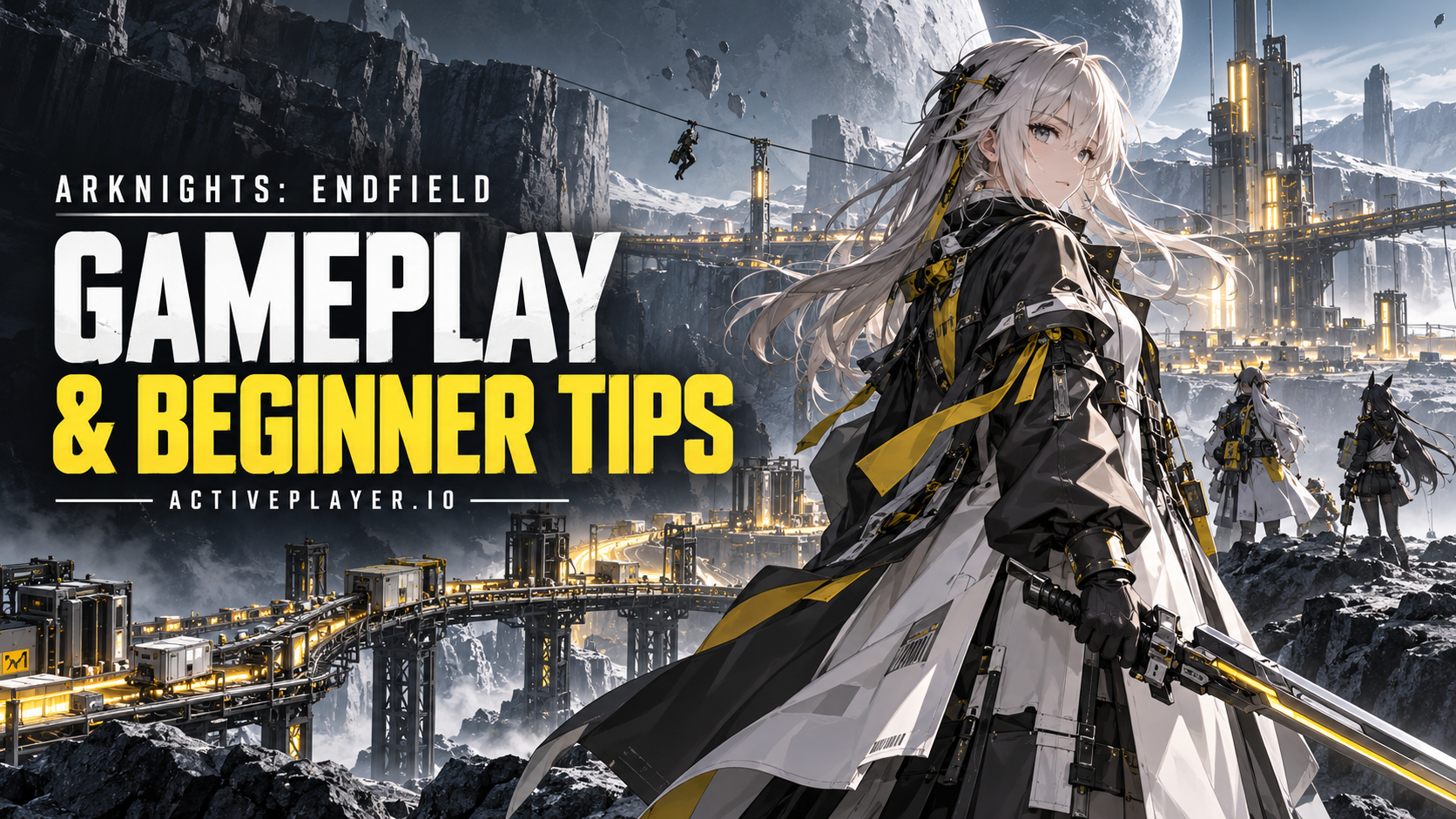
Featured image: original AI-generated editorial illustration created for ActivePlayer.io.

